The Independent Contractor Checklist: 7 Clauses Every Freelance Agreement Needs
A vague scope of work will cost you thousands in unpaid revisions. Before you write a single line of code or design a single logo, ensure your freelance contract contains these seven critical clauses.

TABLE OF CONTENTS (9 SECTIONS)TAP TO EXPAND
- The Danger of the Handshake Agreement
- 1. The Explicit Scope of Work (And Non-Scope)
- 2. Payment Milestones and Late Fees
- 3. The Revision Boundary
- 4. Intellectual Property (IP) Transfer Condition
- 5. The “Kill Fee” (Cancellation Clause)
- 6. Communication and Availability Boundaries
- 7. Independent Contractor Status
- Practical Workflow: How to Send Contracts Without the Friction
The Danger of the Handshake Agreement
“We love your portfolio! Can you start on Monday? We can figure out the exact details later.”
This is the most dangerous sentence a freelancer will ever hear. When you begin work without a signed agreement, you surrender all leverage. You leave the definition of “done,” the schedule of payment, and the ownership of intellectual property entirely up to the client’s interpretation.
A strong freelance contract is not about threatening legal action; it is a communication tool. It forces both parties to align their expectations before money changes hands.
Use this 7-point freelance contract checklist to audit your current agreement and protect your business in 2026.
1. The Explicit Scope of Work (And Non-Scope)
The Scope of Work (SOW) is the beating heart of your contract.
- What to include: Exactly what you will deliver, quantified. Not “a website design.” You must write: “A 5-page responsive website design consisting of Home, About, Services, Contact, and Blog layout in Figma.”
- The Anti-Scope: You must explicitly list what is not included. “This scope does not include copywriting, stock photography licensing, or custom illustration.”
2. Payment Milestones and Late Fees
Never agree to 100% payment upon completion. If the client delays giving you feedback for three months, your payment is held hostage.
- Structure: Require a deposit to secure space in your schedule (e.g., 50% upfront, 50% upon delivery). For larger projects, use milestone billing (30% upfront, 30% after structural approval, 40% upon final delivery).
- Late Fees: State your late fee policy clearly. “Invoices are Net-15. A late fee of 1.5% per month will be applied to all overdue balances.”
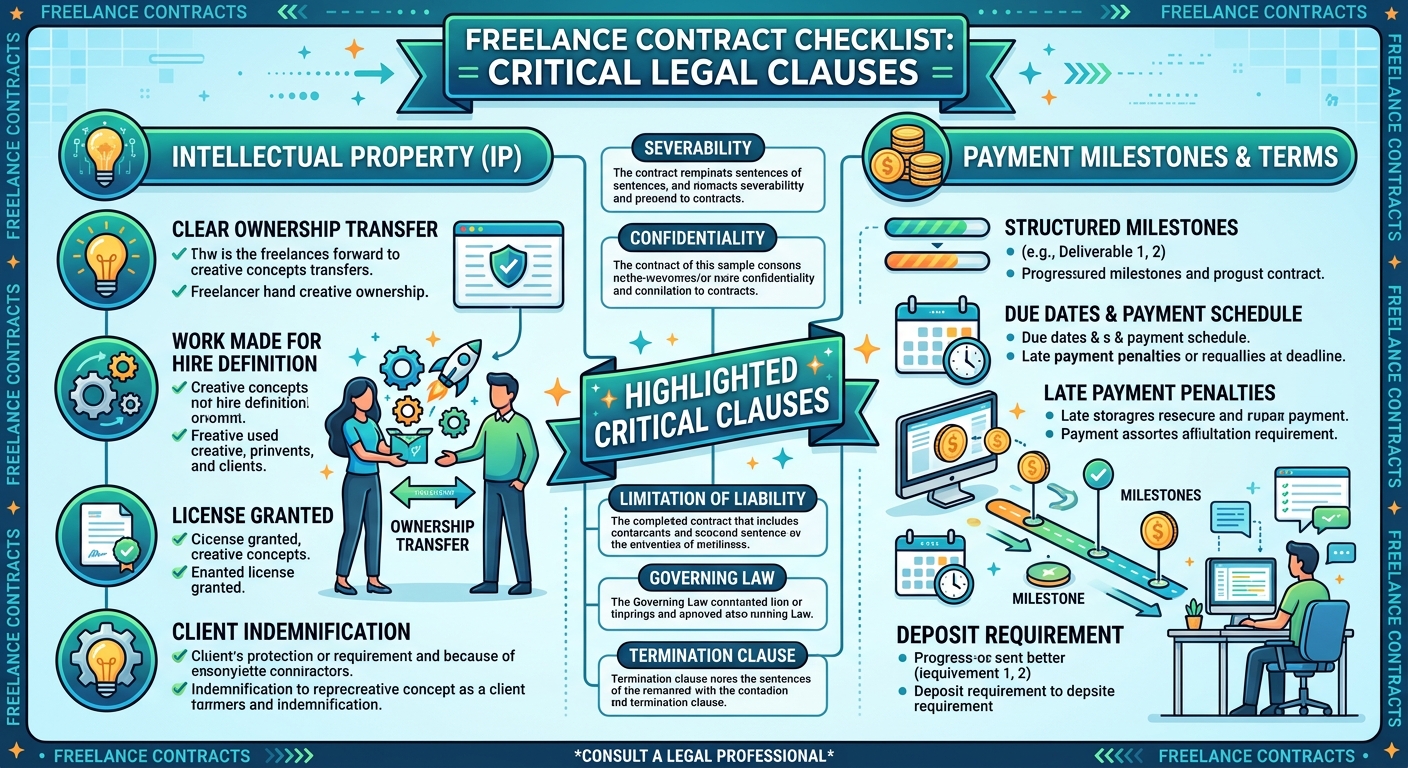 Utilizing dedicated proposal software ensures your payment milestones and late fee terms are permanently attached to the client’s digital signature.
3. The Revision Boundary
Scope creep—the slow, creeping expansion of a project’s requirements—will destroy your hourly rate.
- Define the limit: “This agreement includes two (2) rounds of revisions per deliverable.”
- Define the penalty: “Any additional revisions beyond the included two rounds will be billed at my standard hourly rate of $150/hr, subject to my availability.”
4. Intellectual Property (IP) Transfer Condition
Who owns the work? In most jurisdictions, the creator owns the copyright until it is explicitly transferred.
- The Golden Rule: The contract must state that the IP rights transfer to the client ONLY upon receipt of full and final payment.
- Portfolio Rights: Ensure you retain the right to display the completed work in your portfolio and marketing materials. Do not let a blanket Non-Disclosure Agreement (NDA) prevent you from showcasing your best work.
5. The “Kill Fee” (Cancellation Clause)
What happens if the client goes bankrupt, changes strategic direction, or simply disappears halfway through the project?
- The Clause: Include a cancellation policy stating that if the project is terminated by the client for reasons outside your control, you retain the non-refundable deposit. Furthermore, if the work completed exceeds the deposit amount, the client will be billed pro-rata for the remaining time.
6. Communication and Availability Boundaries
Clients who text you on Sunday morning asking for “urgent” updates will quickly lead to burnout.
- Set the standard: Define your working hours and communication channels directly in the contract. “Standard communication will occur via email between 9 AM and 5 PM EST, Monday through Friday. Please allow 24 hours for email responses.”
7. Independent Contractor Status
To protect the client from tax liabilities and labor disputes, the contract must explicitly state your legal relationship.
- The Clause: State clearly that you are an independent contractor, not an employee. You are responsible for your own taxes, you provide your own equipment, and you dictate the hours and location of your work.
Practical Workflow: How to Send Contracts Without the Friction
Drafting a custom Word document, converting it to a PDF, and asking the client to print, sign, and scan it back is an outdated, high-friction process.
To streamline this, integrate your contract directly into your sales pipeline:
- Track your incoming leads using a lightweight freelance CRM.
- When a client agrees to move forward, use dedicated proposal and e-signature software (like PandaDoc or Bonsai).
- These tools allow you to embed your 7-point contract directly beneath the project proposal, allowing the client to review the SOW and legally sign the document with a single click.
- Once signed, the platform automatically generates and sends the invoice for the upfront deposit directly to your automated bookkeeping system.
Do not begin work until the digital ink is dry and the deposit has cleared your bank account.
WHAT WE APPRECIATED (PROS)
- ✓Eliminates scope creep by explicitly defining what is NOT included
- ✓Guarantees cash flow through structured payment milestones
- ✓Protects your intellectual property until final payment is received
- ✓Establishes clear boundaries for communication and revisions
DRAWBACKS & FRICTION (CONS)
- ✕Requires upfront friction and negotiation with new clients
- ✕Legal jargon can intimidate smaller, unsophisticated clients if not explained
- ✕Enforcing a contract across international borders can be practically difficult
The Independent Contractor Checklist: 7 Clauses Every Freelance Agreement Needs Rating Breakdown
All freelancers, regardless of discipline, who are transitioning from casual marketplace gigs to direct, high-value client relationships.
A robust contract is the highest ROI tool in a freelancer's arsenal. It establishes professional authority, defines the exact boundaries of 'done', and ensures you get paid on time.
EVALUATION METRICS
Speed of setup, friction in daily operations, and intuitive mental model for non-enterprise users.
Utility of capabilities without unnecessary enterprise bloat that slows down solo execution.
Return on investment for a single seat, clear billing tiers, and fair feature gates.
Uptime track record, offline resilience, and friction-free portable data export.
Specific suitability for client collaboration, single-seat economics, and lean overhead.
Frequently Asked Questions
Do I need to hire a lawyer to draft my freelance contract?+
While highly recommended for high-stakes enterprise work, most solo freelancers can safely use vetted templates provided by professional organizations (like the Freelancers Union) or premium contract software platforms.
What if a client refuses to sign my contract and insists on using theirs?+
This is common with enterprise clients. If you use their Master Services Agreement (MSA), you MUST read it entirely. Pay specific attention to 'Work for Hire' clauses and Net-60 or Net-90 payment terms that could severely delay your cash flow.
Can an email chain serve as a legal contract?+
In many jurisdictions, written email agreement to terms can constitute a binding contract. However, relying on scattered emails instead of a centralized, signed document makes resolving disputes incredibly difficult.

Freelance Tool Guide Team
The editorial team behind Freelance Tool Guide, independently researching and testing software for freelancers and small teams.
More Independent Software Analyses

Best Proposal Software for Freelancers: Free & Paid Options
Win bigger client contracts with less friction. We test the best proposal software and e-signature tools for freelancers, comparing speed, analytics, and templates.
Best CRM Software for Freelancers: Free & Affordable Options
Managing client leads across messy spreadsheets? Discover the best CRM tools for solo consultants and freelancers to track deals, follow-ups, and retainer value.

How to Automate Your Freelance Bookkeeping (With Zero Accounting Experience)
Stop spending weekends doing manual data entry. Learn how to automate your freelance bookkeeping using Xero, QuickBooks, or Wave in 5 practical steps.